
The Heart of Your Solar Setup: Why the Right Inverter Matters
Switching to solar energy is one of the smartest financial decisions a homeowner can make. However, buying the best solar panels is only half the battle. The true engine of your system is the solar inverter. It acts as the brain of your setup, converting the raw Direct Current (DC) generated by your panels into the usable Alternating Current (AC) that powers your fans, TVs, and refrigerators.
If you pick an underpowered or incompatible unit, your entire investment will underperform. So, how do you choose the best solar inverter for home use? Let’s break it down into four simple steps.
Step 1: Calculate Your Home Load Requirement
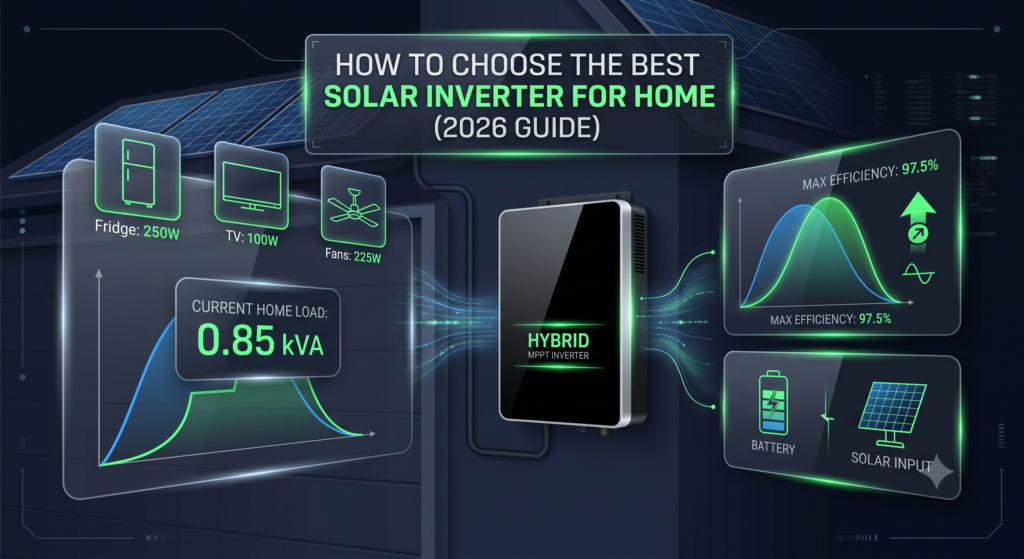
Before looking at brands or prices, you must know your total power requirement. Solar inverters are rated in VA (Volt-Ampere). To find your ideal VA rating, you need to calculate the wattage of all the appliances you plan to run simultaneously during a power cut.
- Ceiling Fans: 3 fans × 75W = 225W
- LED Tube Lights: 4 lights × 20W = 80W
- Television: 1 LED TV = 100W
- Refrigerator: 1 Fridge = 250W
- Total Load: 655 Watts
Because inverters are not 100% efficient (most operate at a power factor of 0.8), you should divide your total wattage by 0.8 to get your required VA rating. For a 655W load, you need a minimum of an 820VA inverter. We always recommend rounding up to a 1kVA (1000VA) unit for safety and future appliance additions.
Step 2: Choose the Right Inverter Type
Not all solar inverters do the same job. Depending on your area’s grid stability, you will need to choose from three main types:
- On-Grid Inverters: Best for areas with rare power cuts. They feed excess solar power back into the government grid to lower your electricity bill, but they do not support battery backups. If the grid fails, your power goes out.
- Off-Grid Inverters: Ideal for remote areas with no grid connection. They store all solar energy in batteries.
- Hybrid Solar Inverters: The ultimate choice for Indian homes. Hybrid inverters give you the best of both worlds—they connect to the grid to save you money on bills, but they also charge a battery bank to keep your home running seamlessly during localized power outages.
Step 3: Look for MPPT Technology (Not PWM)
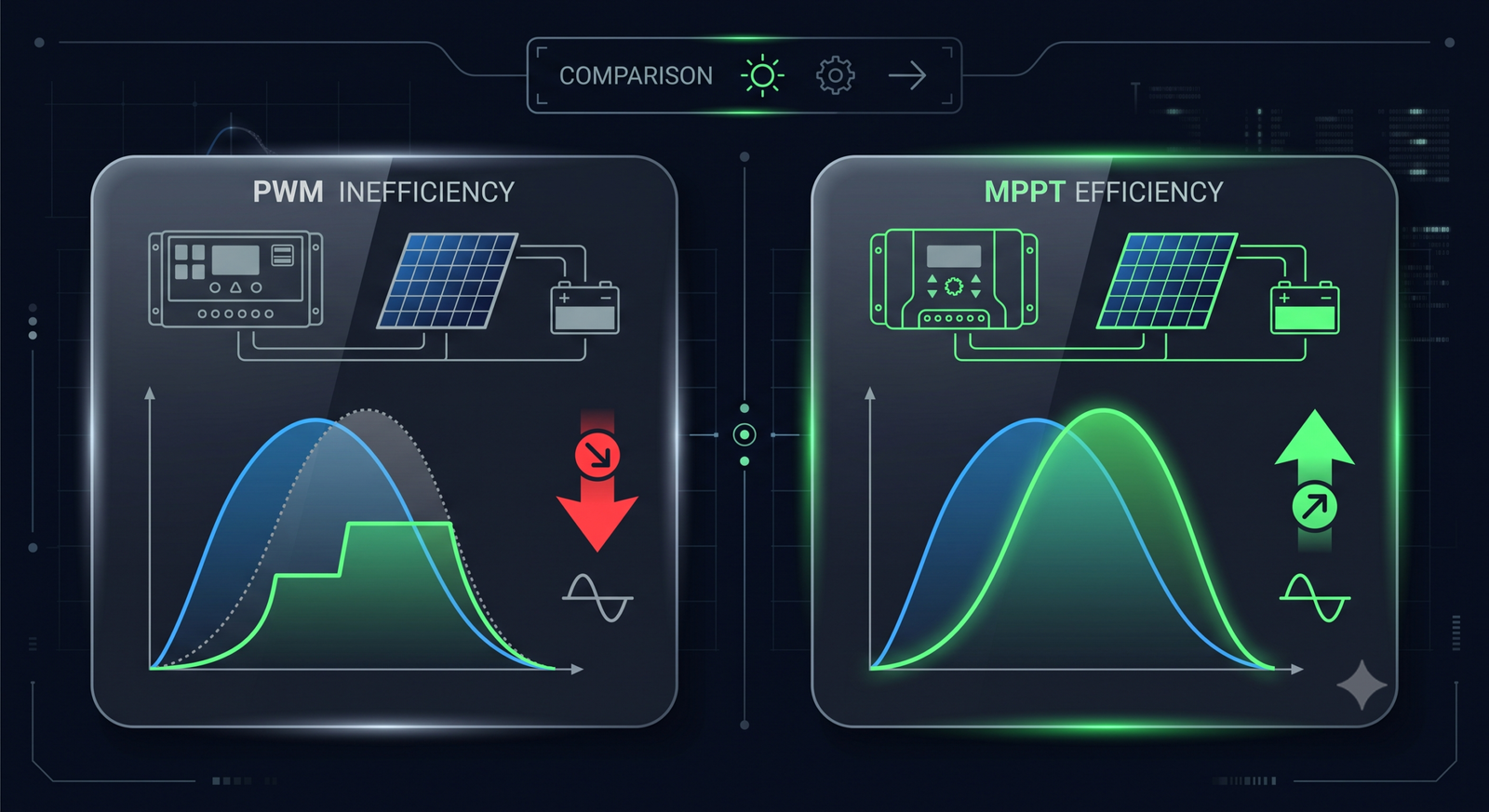
When shopping for the best solar inverter for home setups, you will encounter two types of charge controllers built into the units: PWM (Pulse Width Modulation) and MPPT (Maximum Power Point Tracking).
Always opt for MPPT technology. While PWM inverters are cheaper upfront, they waste up to 30% of the solar energy generated by your panels. MPPT technology actively tracks the maximum power point of your panels throughout the day, ensuring you harvest 30% more energy, especially during cloudy days or winter months.
Step 4: Battery Compatibility and Scalability
Your solar inverter needs to be perfectly matched with your battery bank. If you plan to use a 1kVA inverter, it will typically require a 12V system (one battery). A 2kVA to 3kVA system usually requires a 24V system (two batteries connected in series).
Furthermore, check if the inverter supports modern Lithium-ion (LiFePO4) batteries alongside traditional tall tubular lead-acid batteries. Lithium batteries charge faster, last three times longer, and are becoming the standard for premium home solar setups.
Final Verdict: Future-Proofing Your Home
Choosing the best solar inverter for your home doesn’t have to be complicated. By calculating your load accurately, opting for a Hybrid MPPT system, and ensuring battery compatibility, you safeguard your home against power outages and rising utility costs for the next decade.
If you are unsure about the exact specifications required for your property, the experts at Odinson Energy are here to help you size, select, and install the perfect hybrid solar inverter for your specific needs.
